 IIUI mission is to transform the society by promoting education, training, research, technology, and collaboration for reconstruction of human thought in all its forms on the foundations of Islam.
 IIUI mission is to transform the society by promoting education, training, research, technology, and collaboration for reconstruction of human thought in all its forms on the foundations of Islam.
IIUI vision to be an excellent University in diversity, knowledge, research, and innovation for the benefits of society and the Muslim Ummah.
IIUI mission is to transform the society by promoting education, training, research, technology, and collaboration for reconstruction of human thought in all its forms on the foundations of Islam.
IIUI vision to be an excellent University in diversity, knowledge, research, and innovation for the benefits of society and the Muslim Ummah.
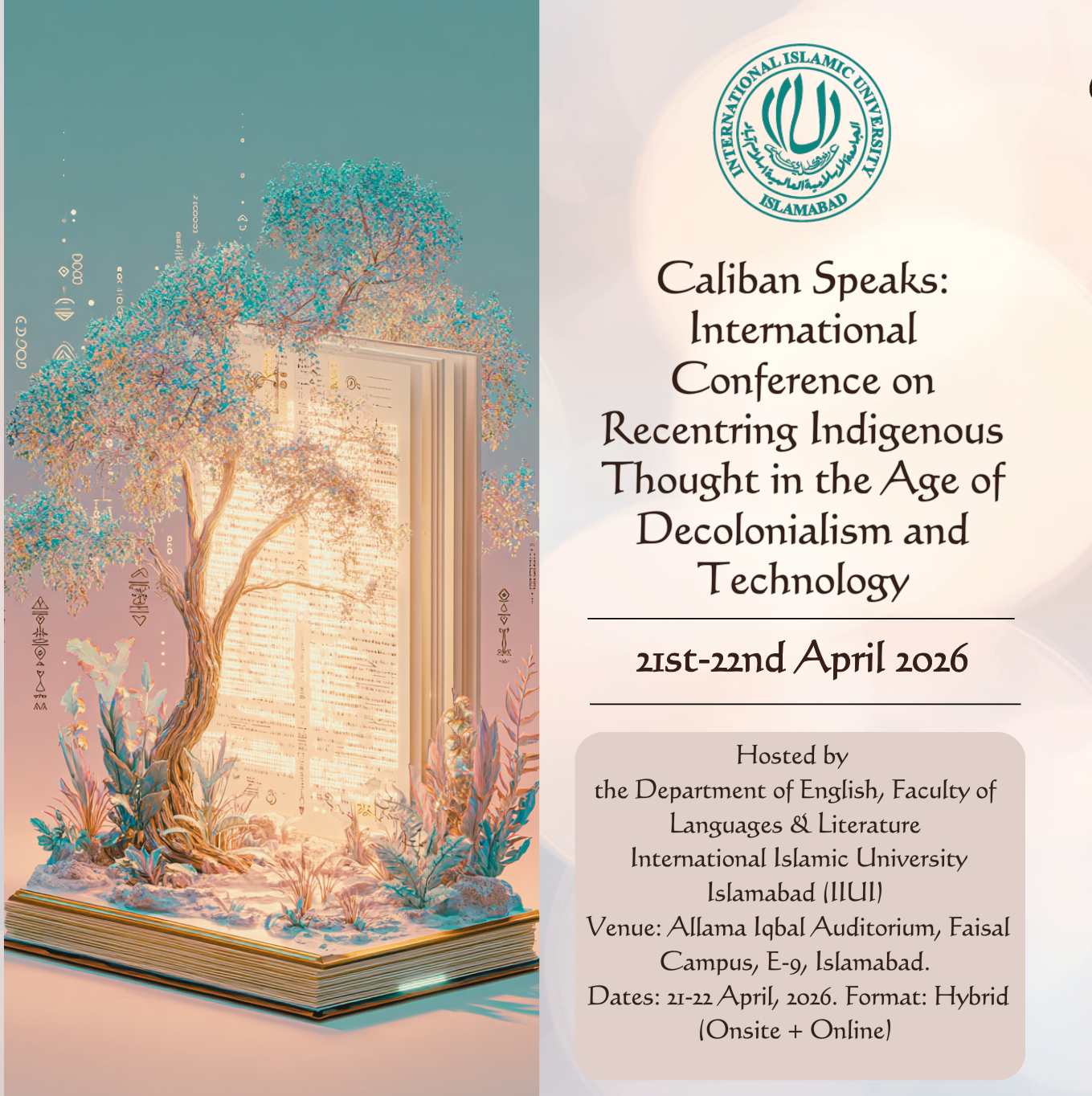
Call for PapersCaliban Speaks: International Conference on Recentering Indigenous Thought in the Age of Decolonialism and TechnologyApril 21–22, 2026 | International Islamic University Islamabad (IIUI)
Conference Rationale
This conference intervenes by advancing Indigenous thought in dialogue with Western epistemologies through pluriversal hermeneutics. Rather than following a hierarchical, mountain-like model of knowledge (with one tradition standing above others), the conference envisions a plateau-like structure where multiple discourses interact transversally. Within this framework, Western and non-Western epistemologies engage not in opposition but in reciprocal dialogue, generating layered and shared understandings.
Caliban Speaks: The International Islamic University Islamabad (IIUI) provides a particularly unique vantage point for this undertaking. With its multi-epistemic structure and multicultural environment, the University is itself a living embodiment of colonial dialogue: a site where Islamic, local, and Western intellectual traditions continuously intersect, often in tension yet always in conversation. Its treasure trove of rare texts further enriches this position, anchoring contemporary debates in a deep historical archive. At the same time, the University functions as a theater of interdisciplinary engagement, where multiple subjects converge to establish fruitful nexuses for reviving neglected intellectual traditions. This vantage point enables the articulation of decolonial thought not as a rejection of Western contributions, but as an engaged praxis: critically attentive to the ramifications of colonial interventions in the region over the last two to three centuries, while also acknowledging the productive dialogues that emerged from those encounters. From this position, IIUI is uniquely placed to demonstrate how decolonial work can be transformative — not by discarding, but by critically reworking and re-situating, diverse intellectual inheritances. Caliban Speaks insists that decoloniality must not harden into yet another abstract framework. Instead, it must remain a praxis-oriented tool: one that critiques structures of power while generating actionable strategies for intellectual, cultural, and social transformation. The conference is designed to move beyond academic abstraction by incorporating art, storytelling, digital interventions, and activist practices, ensuring that its outcomes resonate both within and outside academic circles. The uniqueness of this initiative lies in its commitment to plurality and praxis: diverse voices will converge to challenge colonial residues in thought, language, pedagogy, and technology, while building pathways for new, shared futures. Beyond scholarship, the conference will stimulate curricular reforms, activist collaborations, and creative productions, contributing to a living, dialogic practice of decoloniality. |