

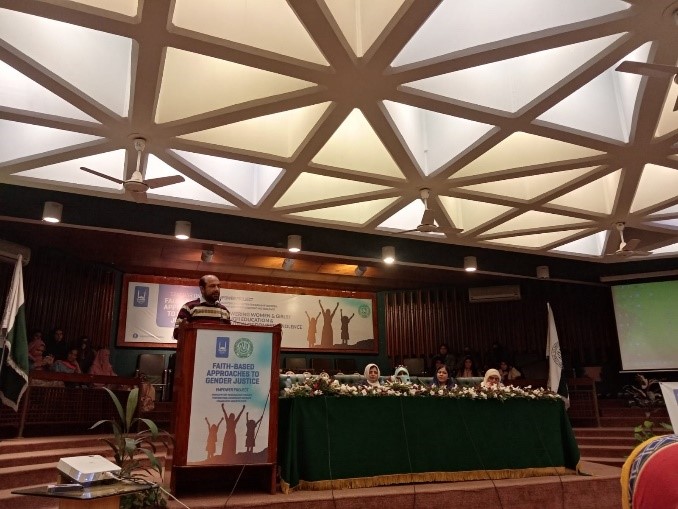
 A seminar titled “Faith-Based Approaches to Gender Justice: Empowering Women and Girls Through Education and Prevention of Domestic Violence” was held in the Allama Iqbal Auditorium, Old Campus. The event was organized by the Department of Sociology, Faculty of Social Sciences (FSS), in collaboration with Islamic Relief Pakistan (IRP). It brought together students, faculty members, and experts to address critical issues surrounding gender justice, education, and domestic violence.
Dean of the Faculty of Social Sciences, Professor Dr. Manzoor Khan Afridi, was the Chief Guest of the seminar.
On this occasion, Professor Dr. Manzoor Khan Afridi stressed the transformative power of education in achieving empowerment, engagement, and emancipation. He highlighted the importance of deconstructing cultural taboos and promoting inclusive narratives. “To understand perspectives, we first need to understand their constructs,” he remarked, encouraging collective responsibility towards transformative education.
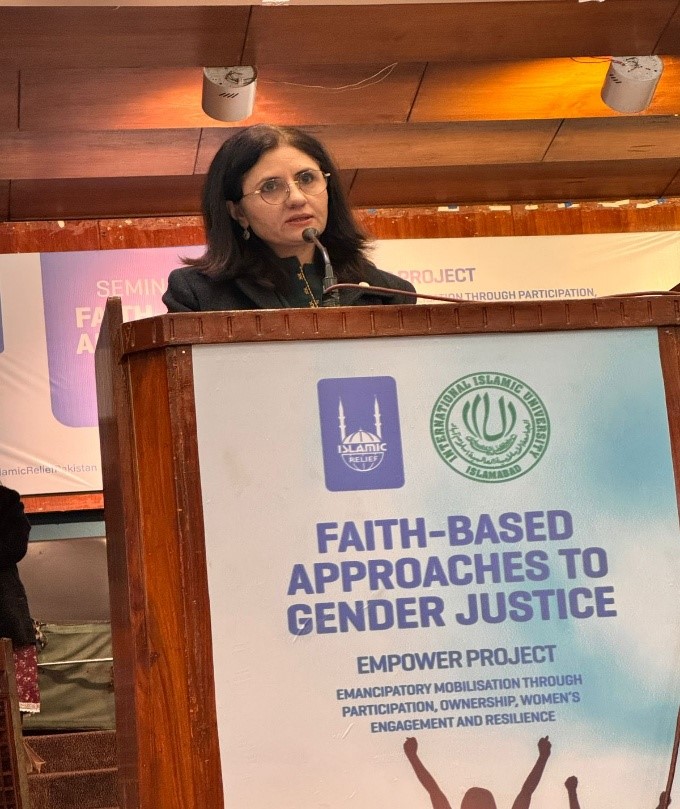 In her welcome address, Dr. Rabia Ali, Incharge of the Department of Sociology, emphasized that gender inequalities in Pakistan are deeply rooted in socio-cultural factors. She underscored that solutions must be culturally acceptable and introduced the EMPOWER project, coordinated by Islamic Relief Worldwide and funded by IR Canada. The initiative aims to address gender inequality by leveraging faith-based teachings, involving religious scholars and faith leaders to challenge patriarchal norms, and promoting education and legal protection as tools to prevent domestic violence.
Mr. Raza Neraijo, Deputy Country Director of Islamic Relief Pakistan, thanked the IIUI faculty and students for their participation. He provided an overview of IRP’s global initiatives, stressing the need for empowerment and awareness in challenging environments where women face systemic struggles.
Dr. Ruksana Tariq, Student Advisor Female Campus, underscored the importance of addressing gender-related issues in academic spaces and encouraged students to organize similar events to foster dialogue.
 The event’s central focus was an engaging panel discussion on faith-based approaches to gender justice. The panel featured Dr. Faryal Umbreen, Incharge Dawa Center; Dr. Noreen Saher, Associate Professor Anthropology; Ms. Afshan Jamal from Islamic Relief Pakistan; and Ms. Abida Farheen. In the first round of discussions, panelists explored theoretical frameworks of domestic violence, including relational, social-ecological, and traumatic models. The speakers emphasized the role of families in fostering harmony while addressing societal taboos through Islamic principles and sociological perspectives. Policies to address domestic violence and the challenges of implementation were also discussed.
The second round highlighted girls’ education as a critical issue, emphasizing the socio-cultural pressures women face. Panelists stressed the role of education in holistic personality development and called for inclusive and responsive educational policies rooted in Islamic principles.
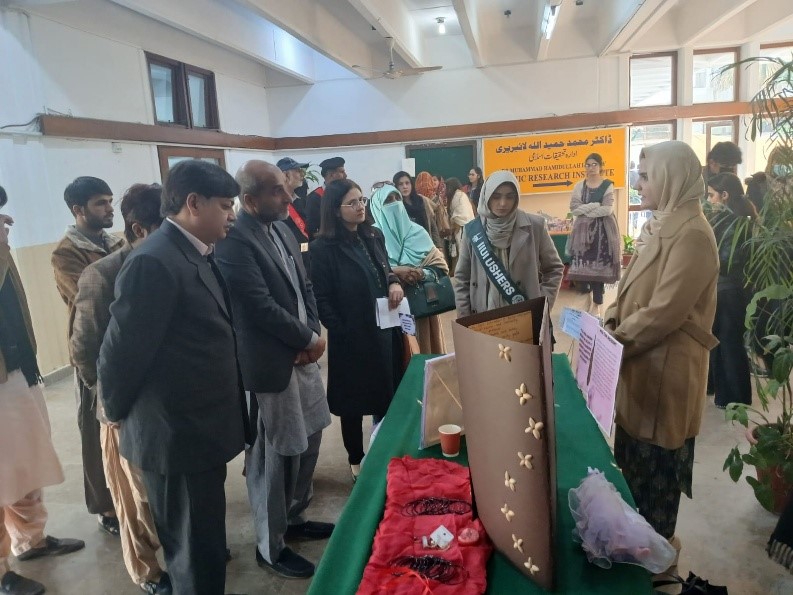
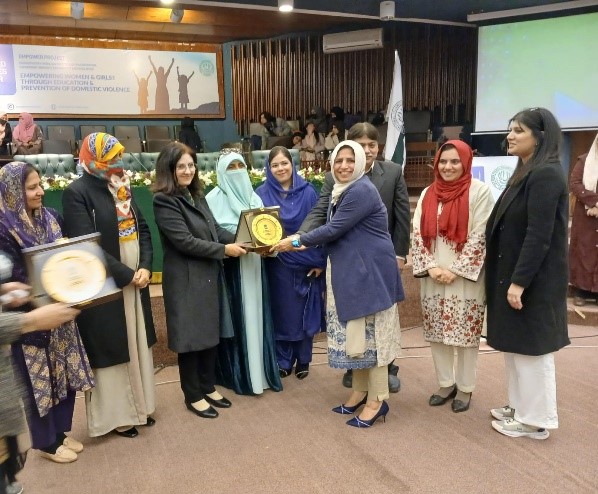
The event also featured poster presentations by MS Sociology students on themes related to gender violence and girls’ education. Faculty members and external experts evaluated the posters, and certificates and prizes were awarded to the participants.
 In his concluding remarks, Dr. Babar Akram, Chairman Department of Sociology, summarized the event and emphasized the need to combine faith-based approaches with sociological evidence to address gender justice effectively. He thanked Islamic Relief Pakistan for their support and appreciated the efforts of the Department of Sociology for organizing the seminar.
The seminar concluded with a vibrant Q&A session, where participants discussed topics such as spouse selection, women’s empowerment in underprivileged regions, and the interplay of religion and educational culture. The event ended on an optimistic note, celebrating the collective efforts towards empowering women and addressing domestic violence through faith-based and culturally sensitive approaches.